Most free expense tracker apps aren't actually free. You get 14 days, then a paywall. Or a limited version that hides the features you actually need behind a monthly subscription.
This article covers the 9 best options in 2026, tools tested for real daily use.
Whether you're a freelancer, a couple, or a first-time budgeter, there's a genuinely free option here that works.
The good news is several apps in this space offer free forever tiers that are actually usable.
No credit card required. No 7-day countdown. No surprise upgrade prompts after you've already imported three months of transactions.
We'll break down what each app does well, who it's built for, and where it falls short, so you can pick the right one without wasting a weekend testing them all.
Already budgeting as a couple? See our full guide to the best budgeting apps for couples.
Why most 'free' expense trackers aren't actually free
Let's be direct about what's broken in this market:
14 or 30-day access, then a $10–$15/month subscription.
You can log expenses but not export, analyze, or set budgets.
Free tier only connects one bank account or one user.
Constant pop-ups bothering you while you check what you spent on groceries.
Apps like Mint shut down without warning, leaving users desperate for another option.
Monthly summaries and spending insights locked behind paid tiers.
If you've been looking for a truly free expense tracker, the apps below are the ones worth your time.
Quick Comparison
App | Free Tier | Best For | Key Strength |
|---|---|---|---|
ExpenseSumo | Free forever | Individuals + freelancers | Clean UI + no trial required + Easy to use |
Pocket Clear | Free forever | Zero-based budgeters | Simple envelope method |
Empower (Personal Capital) | Free forever | Net worth + investment tracking | Wealth dashboard |
Goodbudget | Free (10 envelopes) | Envelope budgeting beginners | Couples & shared budgets |
EveryDollar | Free basic tier | Dave Ramsey followers | Zero-based budgeting method |
Spendee | Free (1 wallet) | Visual spenders | Beautiful spending charts |
Honeydue | Free forever | Couples | Joint finance tracking |
Ivy Wallet | Free forever | Open-source fans | Offline-first, privacy-focused |
Monefy | Free (with ads) | Minimalists | One-tap expense logging |
ExpenseSumo
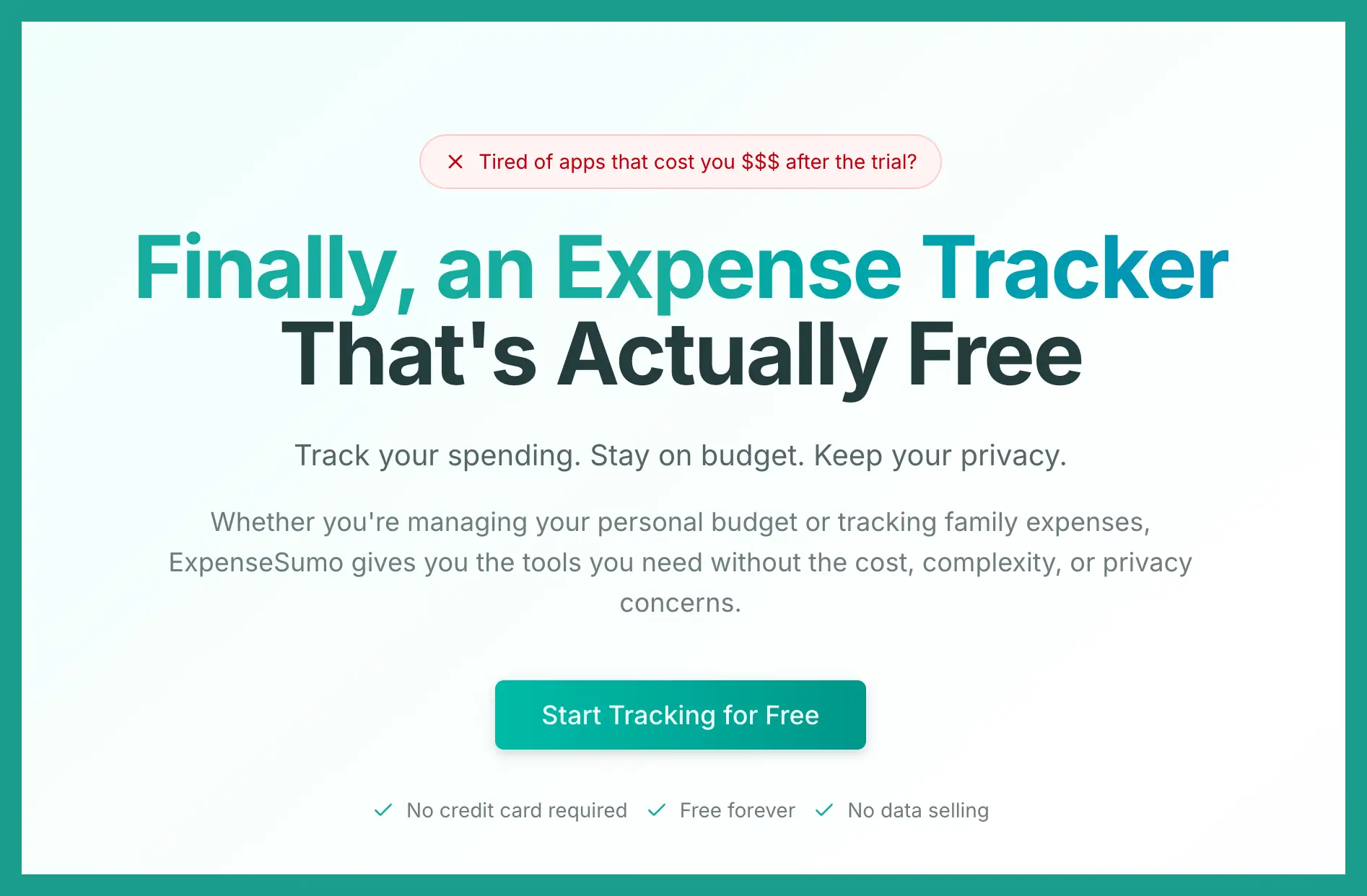
ExpenseSumo is the best overall pick on this list. It's genuinely free. A free forever budget app with no premium tier, no upsell, and no card on file.
The interface is minimal but not underpowered. You get expense logging, category breakdowns, recurring expense tracking, and monthly summaries all on the free plan.
Best For: Individuals, freelancers, and anyone switching from a subscription-based tracker who wants a reliable, cost-free alternative.
Key Features:
Free forever no subscription required.
Manual expense logging with category tagging.
Monthly and weekly spending summaries.
Recurring expense tracking.
Clean, distraction-free dashboard.
Export-ready reports.
Pricing: Free forever. No hidden tiers or paywalled reports.
ExpenseSumo takes the top spot because it's genuine no subscription expense tracker. It's not the most feature-heavy app on this list, but for tracking daily expenses and understanding where your money goes.
It handles the essentials without demanding your credit card details.
If you've come from Mint and you're looking for a straightforward replacement, start here.
Looking for more options? Check our full Mint alternatives guide for a broader breakdown.
Pocket Clear
Pocket Clear takes the zero-based budgeting approach. Every dollar gets a job. The interface is fast, the workflow is obvious. And there's no subscription holding the core features hostage.
It's a great pick if you want more structure than a simple tracker but don't want to learn a complicated system.
Best For: Budgeting beginners who want a guided, zero-based budgeting method.
Key Features:
Zero-based budgeting framework built-in.
Fast manual expense entry.
Budget category templates.
Spending vs. budget visual comparisons.
Lightweight and mobile-first.
Pricing: Free forever on the core plan.
Pocket Clear fills a real gap. It gives you YNAB-style thinking without the $14.99/month price tag. The free tier covers everything a new budgeter needs. It doesn't connect to your bank automatically.
Not for power users who want deep analytics. But for building a budgeting habit from scratch? It's a strong free choice.
Empower
Empower is the most powerful free financial app on this list. But it's designed more as a wealth tracker than a pure expense tool. You connect your accounts and get a full picture of assets, liabilities, investments, and cash flow.
The expense tracking is solid, but it's a bonus feature here, not the headline.
Best For: People who want to track spending and see their complete financial picture investments, retirement accounts, and net worth all in one place.
Key Features:
Net worth dashboard.
Automatic transaction syncing.
Investment performance tracking.
Cash flow analysis.
Retirement planning tools.
Fee analyser for investment portfolios.
Pricing: Free forever for the personal finance tools. Wealth management services are paid and advice-based.
Empower's free tier is genuinely impressive. It's the most data-rich free financial app available right now. The trade-off is that Empower will eventually pitch you their wealth management service.
If you're only tracking $500/month in groceries, this is overkill. But if you want to watch your money grow across multiple accounts while also tracking daily expenses, nothing free comes close.
Goodbudget
Goodbudget is a great free digital envelope budgeting app. You divide your income into virtual envelopes, rent, groceries, dining out, and spend from each one until it's empty. It's an old-school method that works surprisingly well.
The free tier is generous enough for serious use.
Best For: Couples or households who want a shared budgeting system based on the envelope method.
Key Features:
10 regular envelopes on the free plan.
Shared budgets across devices.
Debt tracking included.
Sync across up to 2 devices.
Transaction history up to 1 year.
Available on iOS and Android.
Pricing: Free forever (10 envelopes, 2 devices). Plus plan at $10/month for unlimited envelopes.
Goodbudget's free plan is genuinely usable 10 envelopes covers most household budget categories. The envelope method works well for people who overspend because it creates a visual stop point per category.
The limitation is manual entry, there's no automatic bank sync. You import transactions yourself, which some users see as a feature (mindful spending) and others see as friction.
EveryDollar
EveryDollar is the official budgeting tool from Ramsey Solutions. It follows the zero-based budgeting method, income minus all assigned categories equals zero. The free tier is manual, but it's clean and functional.
Best For: Dave Ramsey followers or anyone committed to the zero-based budgeting approach who doesn't want to pay.
Key Features:
Zero-based budgeting framework.
Monthly budget creation and tracking.
Debt payoff tracking.
Simple, guided interface.
iOS and Android apps.
Budget templates to start fast.
Pricing: Free basic plan. Premium "Ramsey+" plan at ~$17.99/month adds bank sync and extra features.
EveryDollar is well-made and the zero-based method is proven. The free tier works but the friction of manual entry is deliberate. They want you to upgrade for bank sync, and the upsell is a constant presence.
If you're already in the Ramsey ecosystem, this is the obvious choice. If you're not, Pocket Clear gives you a similar method with less brand baggage.
Spendee
Spendee is one of the most visually polished expense tracking apps in 2026. Charts, color-coded categories and clean spending breakdowns make it easy to understand your money at a glance.
Best For: Visual learners who want to understand their spending through charts and category breakdowns rather than spreadsheet-style tables.
Key Features:
Beautiful spending charts and category breakdowns.
Manual and automatic transaction entry.
Shared wallets for couples or households.
Bill tracking and upcoming expense reminders.
Multi-currency support.
iOS and Android.
Pricing: Free (1 wallet, manual entry). Premium starts at $2.99/month for bank sync and unlimited wallets.
Spendee is the best-looking free expense tracker app on this list. If you've ever found budgeting apps too confusing to use consistently, Spendee fixes that problem. The free tier is limited to one manual wallet, with no automatic bank sync and no multiple accounts.
For light use, that's fine. But if you have multiple accounts to track, the one-wallet limit gets frustrating fast.
Honeydue
Honeydue was built specifically for couples who want to manage money together. You each connect your accounts, choose what to share, and get a joint view of bills, budgets, and spending.
Best For: Couples who want transparency around shared finances without giving up individual account privacy.
Key Features:
Joint dashboard for couple finances.
Each partner chooses visibility per account.
Bill reminders and shared bill tracking.
In-app chat and emoji reactions on transactions.
Automatic bank sync.
Pricing: Free forever. No premium tier currently offered.
Honeydue is the rare app that's entirely free, built for couples, not solo users if you're single, skip this one.
The in-app chat feature is charming depending on who you ask. But the core function seeing both partners finances in one place with privacy controls is genuinely useful and well executed.
Ivy Wallet
Ivy Wallet is a free, open-source expense tracker built for Android. No ads, no subscription, no tracking just a clean, offline-first app for recording what you spend.
Best For: Privacy-conscious users and Android users who want a fully free, no-fine-print expense tracker they can trust.
Key Features:
Completely free and open-source.
Offline-first, works without internet.
Manual expense logging with categories.
Customizable categories and accounts.
Budget planning and goal tracking.
No ads, no data selling, no subscription.
Pricing: Free forever. Open-source on GitHub.
Ivy Wallet is the most trustworthy free app on this list if privacy is a concern. No cloud account required, no behavioral data collection. And the codebase is publicly auditable.
The trade-off is that it's Android-only and lacks the bank sync that convenience-focused users want. But for anyone who's uncomfortable with financial apps having access to their account data, Ivy Wallet is the right call.
Monefy
Monefy is the simplest expense tracker on this list. There's no onboarding, no account setup, no syncing required. Just fast, one-tap expense logging.
Best For: People who've tried complex budgeting apps and given up, people who just want to record what they spend.
Key Features:
One-tap expense entry.
Visual spending wheel by category.
Multiple currencies supported.
Simple monthly budget setting.
Cloud sync via Dropbox or Google Drive.
Pricing: Free with ads. One-time purchase (~$2.99) removes ads and unlocks cloud sync.
Monefy's strength is its speed. There's almost zero friction to logging a transaction. The free version includes ads, which are mild but present. The one-time paid unlock is reasonable.
If your past attempts at expense tracking failed because the app was too complex, Monefy is worth trying. It won't give you deep insights or net worth tracking. It just helps you notice where your money actually goes.
Final Words
Which Free Expense Tracker Should You Use?
Here's the short version based on what you actually need:
Just want the best free option overall, Use ExpenseSumo. Clean, free forever, no tricks.
Budgeting from scratch with zero-based method, Try Pocket Clear first, then EveryDollar if you want more structure.
Tracking investments + daily spending, Empower is on a different level for free.
Budgeting as a couple, Goodbudget for the envelope method, Honeydue if you want a truly joint setup.
Visual learner who needs charts, Spendee wins on design.
Privacy-first, Android user, Ivy Wallet is the only choice worth considering.
Tried everything and quit, Start with Monefy. It's the lowest-friction option available.
No app on this list requires a credit card or a trial. All of them are usable on day one for free.
Interested to try best free expense tracker app in 2026? Create a free account on ExpenseSumo today.
FAQs
What is the best completely free expense tracker app in 2026?
ExpenseSumo is the best truly free expense tracker in 2026. It offers a free forever plan with no trial period, no paywalled features, and no credit card required, making it the most accessible option for individuals and freelancers who want reliable daily expense tracking without a subscription.
Are any expense tracker apps free forever without a subscription?
Yes. Several apps on this list are free forever, including ExpenseSumo, Empower (Personal Capital), Honeydue, and Ivy Wallet. They're permanently free tiers that cover core budgeting and expense tracking features.
What is the best free alternative to Mint after it shut down?
The best free Mint alternatives in 2026 are Empower for users who want automatic bank sync and investment tracking, and ExpenseSumo for users who want a simpler, cleaner manual tracker. See our full Mint alternatives guide for a complete comparison.
Is EveryDollar really free?
EveryDollar has a free basic plan that works, but it's manual entry only. The auto bank sync feature is locked behind the paid "Ramsey+" plan (~$17.99/month). For a fully free zero-based budgeting experience, Pocket Clear is the better no-cost alternative.
What's the best free expense tracker app for couples?
Honeydue is the best free expense tracker specifically built for couples. It's free forever, supports joint dashboards with privacy controls per account, and includes shared bill tracking. Goodbudget is a strong second option if you prefer the envelope budgeting method as a couple.
Is there a free expense tracker no trial that requires no credit card?
Yes. ExpenseSumo is a free expense tracker with no trial, no credit card, and no paywall. You create an account and start logging expenses on day one without entering payment information. Honeydue and Ivy Wallet also offer entirely free experiences with no trial period, though they target different users — couples and privacy-focused Android users respectively.